
| TTI Research Supervisor: Sofokli Cakalli, P.E. Associate Research Engineer Texas A&M Transportation Institute Texas A&M University System TAMU 3135, College Station, Texas, 77843-3135 (512) 998-6039 [email protected] | Pooled Fund Technical Representative: Ryan Owens, P.E. Bridge Design Section LA DOTD, 603-H (225)379-1869 [email protected] |
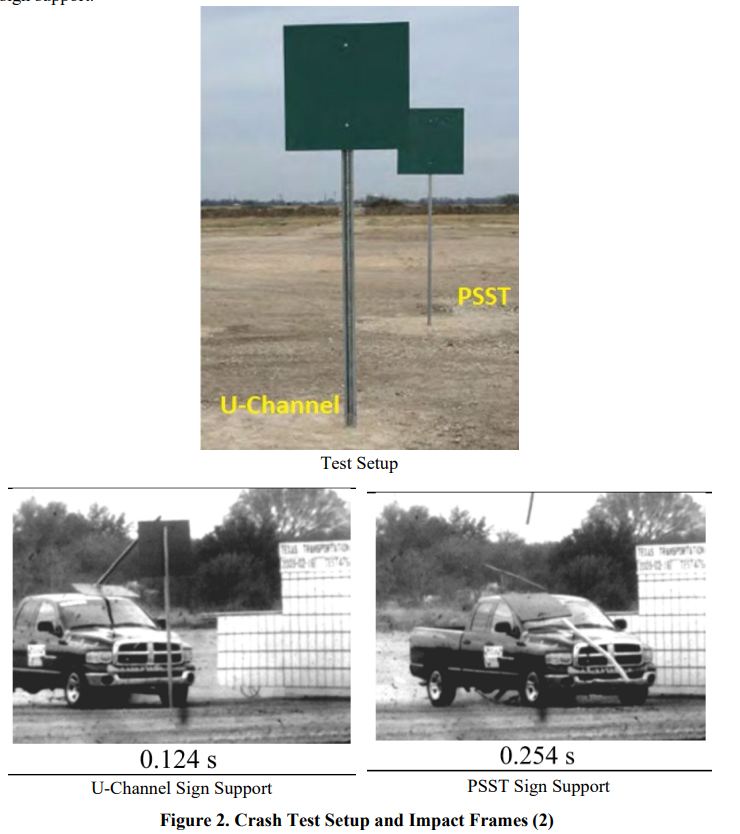
 Under impact by the 2270P pickup, the PSST fractured at bumper height and at the ground stub. The sign panel attachment bolts also failed, allowing the plywood sign panel to separate from the support and strike the windshield directly. The resulting inward deformation of the windshield was 3.5 in., exceeding the MASH limit of 3.0 in. By contrast, the companion U-channel small sign support test in the same series met all MASH criteria. In that test, the sign panel remained attached to the support longer during the impact sequence, and the combined support–sign assembly rotated over the vehicle, passing over the cab without causing excessive windshield or occupant compartment deformation. Figure 2 shows the test set up and frames from MASH Test 3-62 for the U-channel and the PSST sign support.
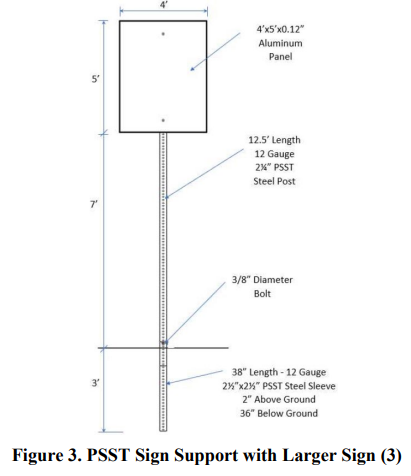
  The differing performance between the U-channel and PSST installations was attributed primarily to the sign-to-PSST connection details and resulting impact dynamics, rather than to the PSST post itself. The earlier research concluded that if the sign panel had remained attached to the PSST support, the overall performance would likely have been similar to that of the U-channel system and the PSST might have satisfied MASH evaluation criteria (2). More recently, additional MASH Test 3‑62 evaluations of PSST sign supports were performed at FHWA’s Federal Outdoor Impact Laboratory (FOIL) with a larger sign (3). In one such test (FOIL Test 23008), a single 12‑gauge 2¼‑in PSST post with a 4 ft × 5 ft × 0.12‑in aluminum sign panel, mounted 7 ft above grade and installed in standard soil with a PSST sleeve, was impacted head‑on at 100 km/h (62.1 mph) by a 2270P pickup (Figure 3).
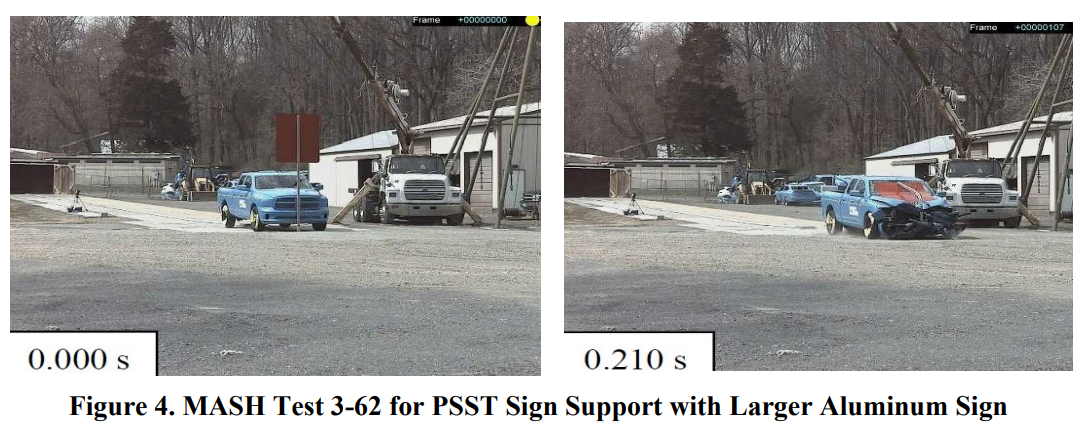
  The post yielded and separated from the sleeve as intended, and no elements penetrated the occupant compartment. However, the aluminum sign panel slammed into the windshield causing 5.0 in of windshield deformation, exceeding the 3.0‑in MASH limit and resulting in a failing outcome for MASH Test 3‑62. Figure 4 shows two frames from that test.
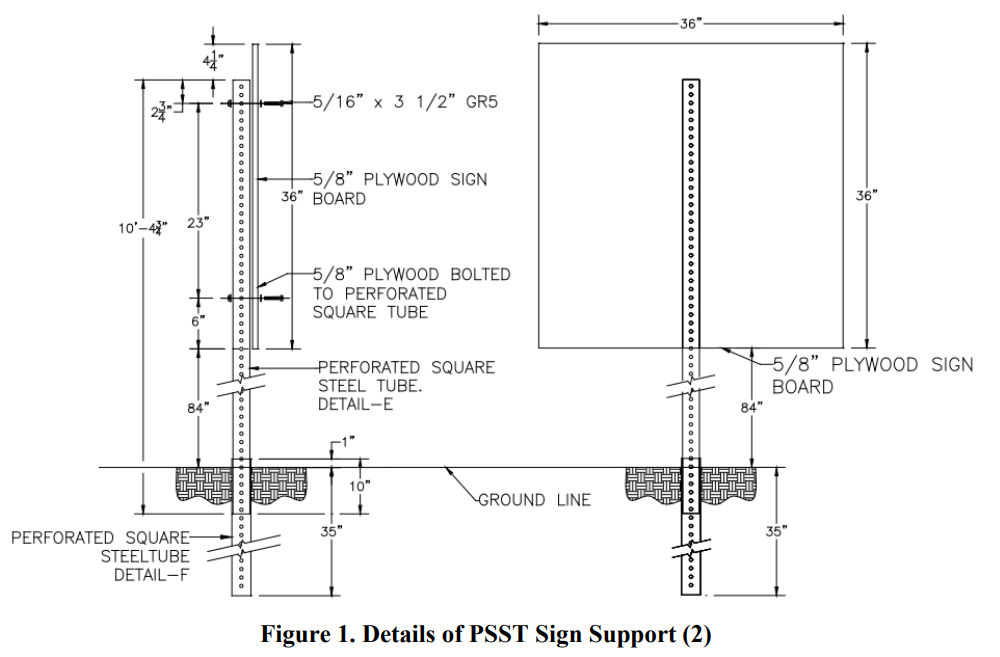
  Both studies demonstrate that the primary concern is not activation of the breakaway mechanism, but the behavior of the sign panel and its attachment as the system interacts with and deforms the windshield. Previous tests indicate that if the sign panel can be kept attached to and rotating with the post, the overall impact dynamics are more favorable, and performance may become comparable to that of U-channel sign support systems that have passed MASH. While this project is particularly focused on addressing the configuration presented in Figure 1, the study presented under NCHRP Web-Only Document 405 further emphasizes the need to develop a MASH-compliant configuration for PSST sign support systems. Despite the extensive use of PSST posts, there is still no PSST-supported sign configuration (panel type, size, and connection details) that has been demonstrated by full-scale testing to satisfy MASH TL-3 criteria. Therefore, there is a need to re-evaluate PSST small sign support installations with more robust sign-to-post connection details. This includes PSST-supported metal (aluminum) sign panels and, if needed, PSST-supported plywood panels with improved attachment hardware, to determine configurations that will prevent excessive windshield deformation and achieve MASH-compliant performance.