Deflection Guideance for Free-Standing PCB with Anchored End-Segments (TTI-625351, T1969-D5)

<<back to search
TTI Research Supervisor: Nauman M. Sheikh, P.E. Senior Research Engineer Texas A&M Transportation Institute Texas A&M University System TAMU 3135, College Station, Texas, 77843-3135 (979) 317-2695 [email protected] Pooled Fund Technical Representative: Clint McCleery Barrier and Attenuation Manager Traffic and Safety Operations Utah Department of Transportation 4501 South 2700 West Taylorsville, UT 84129 (801) 712-8685 [email protected]

Background (and Problem Statement)

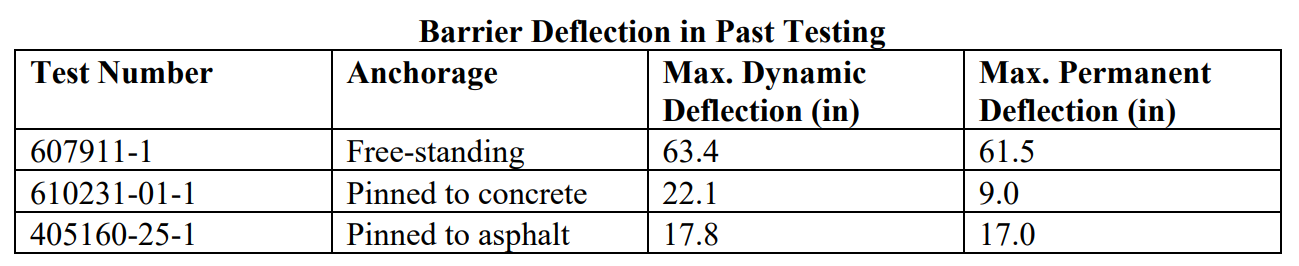
Portable concrete barriers (PCB) placed on roadsides and work zones need to meet the vehicle crash and occupant safety requirements specified in the Manual for Assessing Safety Hardware (MASH) (1). PCBs are usually installed free-standing and unanchored, where they can have large lateral deflection on impact from an errant vehicle. The area behind the barrier needs to be cleared to allow the barrier to deflect as needed. This area also needs to be clear of any construction personnels or equipment to prevent the deflecting barrier from causing injuries or damage on the protected side of the barrier. Since most free-standing PCBs are crash tested with the vehicle impacting near the center of the test installation, the lateral barrier deflections observed in crash testing are not likely to be the same for the end-segments. The end segments are likely to have higher lateral deflection due to loss of continuity near the end. Thus, more clear space is needed behind the barrier. In many situations, the last few segments of free-standing PCBs are restrained by anchoring them to the underlying pavement. This prevents the excessive movement of the end-barrier segments. Currently there is no guidance available on the expected barrier deflection of the free-standing PCB system with anchored barrier segments on each end of the free-standing barrier run. Guidance is needed on the expected barrier deflection, when a vehicle impacts within six barrier segments from the end of such a barrier installation. This information will help determine how far the barrier must be installed past a shielded hazard or a workspace, while allowing sufficient clear space behind the barrier to accommodate the expected barrier deflection due to an impact from an errant vehicle. In Test 607911-1, TTI tested a 32-inch tall F-shape PCB system with 12.5-ft long barrier segments that were connected to each other using a pin-and-loop connection (2). This barrier system was tested free-standing without any anchorage. The maximum dynamic and permanent deflections of the barrier system are shown in the Table below. The same barrier was tested by TTI when anchored to concrete pavement (Test 610231-01-1) and when anchored to 4-inch thick asphalt pavement (Test 405160-25-1) (3,4). The maximum dynamic and permanent deflections in each of these tests are also shown in the table. Since the difference in the maximum dynamic deflection between the free-standing barrier and the barrier pinned to asphalt is greater than the barrier pinned to concrete, placement of the barrier on asphalt is likely to be more critical for determining the deflection guidance near the ends of the barrier installation.

Objective

The objective of this project is to develop guidance for determining appropriate lateral offset(s) near the ends of free-standing F-shape PCB system with anchored end-segments. The research will determine the minimum number of anchored barrier segments needed at each end, the minimum distance the barrier must extend past a shielded hazard or work zone while maintaining the barriers functionality, and provide guidance on lateral barrier placement offsets needed to accommodate changes in barrier deflection near the ends. The research will use the 32-inch-tall, 12.5-ft-long, F-shape barrier design with pin-and-loop connections. The end barrier segments will be anchored to asphalt pavement. The research will use MASH Test Level 3 (TL3) evaluation criteria for determining the performance of the barrier system.

Benefits

Results of this research will provide engineering and testing based guidance to determine proper barrier installation design and layout that accounts for deflection of the barrier system near the ends. This will result in better worker and equipment protection in work zones, and a safer driving environment for the traveling public

Products

This research will provide a final report, crash testing and simulation videos, and guidance for placement of free-standing PCBs.

Work Plan

The work plan for this research includes the following tasks.
Task 1 – Design and Simulation In this task, TTI research team will develop a detailed finite element (FE) model of the 32-inch tall F-shape PCB system with a pin-and-loop connection. The design of the PCB system will be the same as previously crash tested by TTI in 2017 (2). The research team will anchor the end segments of the barrier to asphalt pavement similar to a previously developed anchored configuration crash tested by TTI in 2012 (4). The research team will perform all simulations using LS-DYNA. The research team will perform vehicle impact simulations using impact conditions specified in MASH. The goals of the simulation analyses will be as follows. A. Minimum Anchored Barrier Segments: The research team will determine the minimum number of anchored barrier segments needed at each end of the free-standing PCB installation. While many states use a minimum of three anchored barrier segments, it may be possible to have a functional barrier system with only two or one anchored barrier end-segment. B. Beginning LON and Critical Impact Point: The research team will determine the beginning of length-of-need (LON) and the associated critical impact point (CIP) for the free-standing barrier installation with the anchored end-segments. The research team will perform vehicle impact simulations at various offsets from the end of the barrier system. The simulations will use MASH Test 3-35 impact conditions (i.e., 5,000-lb pickup truck impacting the point of the beginning LON at 62 mph and 25 degrees). The performance of the barrier and the vehicle will be evaluated and compared for each impact point simulation to determine the CIP. This CIP will be crash tested in Task 2 to verify simulation results. Results of these simulations and the eventual crash testing will help determine the minimum distance the barrier must extend past a shielded hazard or work zone while maintaining the barriers functionality (Task 3). C. Barrier Deflection Near Ends: The research team will perform simulations with impacts near the ends of the barrier system to determine the changes to the lateral barrier deflection. The difference between these simulations and the ones performed earlier to determine the CIP is that the vehicle may not be successfully contained near the ends. Even if the vehicle is not fully contained and redirected, knowing the expected barrier deflection will help determine the lateral barrier offset needed for the clear area behind the barrier. Based on the results of the simulations and the behavior of the barrier for endimpacts, the research team will make recommendations for one additional crash test to verify simulation results, which will be performed in Task 2. D. Guideline Development Simulations: Once the full-scale crash testing has been completed under Task 2, the research team will use results of the crash tests to improve validity of the simulation models if needed. The research team will then perform any additional simulations needed to support development of the barrier placement guideline in Task 3.
Task 2 – Construction and Crash Testing In this task, the research team will construct the test installation and perform two crash tests using MASH TL-3 testing and evaluation criteria. The test installation will be comprised of free-standing F-shape barrier segments with anchored end-segments. The actual configuration of the test installation (i.e., number of free-standing and anchored segments) will be determined as part of the simulation analysis in Task 1. However, for the purpose of estimating the construction cost, the research team has incorporated the following: – A 16-segment (200-ft) free standing length of the barrier with additional three anchored segments on each side. – The barrier is placed on asphalt, with the end-segments anchored on minimum 4-inchthick asphalt. – Construction budget for test installation repair and rebuild between two tests is included. – Construction budget for test installation demolition and site restoration after the crash testing is included. Following two tests will be performed.
  1. Test 3-35 with a 5,000-lb pickup truck impacting the barrier at an impact speed and angle of 62 mph and 25 degrees, respectively. The vehicle will impact the barrier at the impact point determined from the simulation analysis in Task 1. This test will determine the performance of the free-standing barrier system with anchored end-segments. The impact will be toward the end of the barrier system with the anchored segments. The system will have the minimum number of anchored segments determined by the simulation analysis performed in Task 1.
  2. Test 3-35 with a 5,000-lb pickup truck impacting the barrier at an impact speed and angle of 62 mph and 25 degrees, respectively. The vehicle will impact the barrier farther downstream of the beginning LON point, at the impact point determined from the simulation analysis in Task 1. Deflection of the barrier in this test will help validate the simulation modeling for the impacts near the ends of the barrier and finalize the placement guidelines.
Task 3 – Installation Guide and Final Report
The TTI research team will use the results of the crash testing and the simulation analysis to prepare guidance for determining appropriate lateral offsets near the ends of free-standing Fshape PCB system with anchored end-segments. The guidance will provide information on the minimum number of anchored barrier segments needed at each end, the minimum distance the barrier must extend past a shielded hazard or work zone while maintaining the barriers functionality, and provide lateral barrier placement offsets needed to accommodate changes in barrier deflection near the ends. The guidance will be provided as part of the final report. The final report will also include details of the simulation analysis, simulation results, crash testing performed, and crash test results. The research team will provide a draft of the final report for review of the Technical Representative. Based on the review comments, the research team will revise the draft report and submit the final report

Time Schedule

Started: May 2026
Time frame: 19 Months

June 11, 2026