
| TTI Research Supervisor: Nathan D. Schulz, Ph.D. Associate Research Scientist Texas A&M Transportation Institute Texas A&M University System TAMU 3135, College Station, Texas, 77843-3135 (979) 317-2695 [email protected] |
Pooled Fund Technical Representative: Andrew Holloway, P.E. Office of Roadway Engineering Ohio Department of Transportation 1980 W Broad Street Columbus, OH 43223 (614)387-4020 [email protected] |
The length of need of guardrail runs is often interrupted by the presence of driveways or intersecting roads. This occurs often adjacent to a bridge which poses unique challenges, but also occurs on longitudinal runs of guardrail at culverts or other hazards. For situations where the drive/side road is adjacent to a bridge, TTI has developed MASH TL-2 and TL-3 short radius systems for TxDOT (1, 2). These systems are not necessarily designed for longitudinal runs of guardrail that are not attached to a bridge railing. Another short radius guardrail system was developed and evaluated in NCHRP Report 1013 (3) for MASH TL-3. Some guidance was developed for using that system with continuous runs of guardrail but requires a significant amount of space.
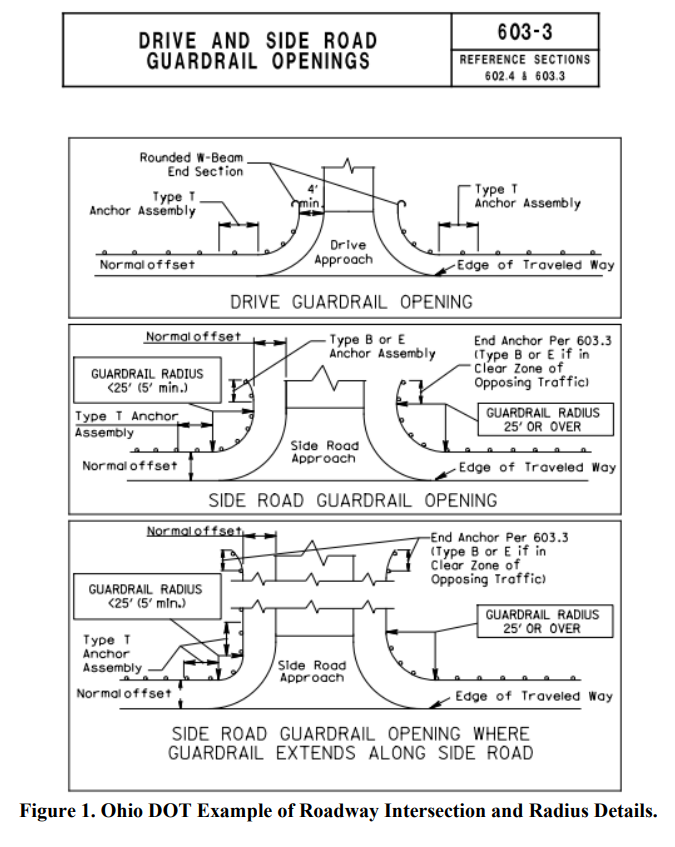
For situations where the drive/side road interrupts the length of need of a guardrail run (not adjacent to a bridge), Ohio DOT has historically used an approach (Figure 1) for radii <25’ of installing a wood-post downstream end anchorage prior to the radius and either a wood-post downstream end anchorage or tangential/flared end treatment following the radii along the side road/driveway. For radii 25’ or greater, ODOT just installs the radius and terminates with the appropriate end treatment. Occasionally, the system will be terminated with a tangential end treatment short of the drive/side road interruption and fail to meet the length of need, especially when the intersecting drive is at a steep grade.
In situations where the drive/side road is adjacent to a bridge, Ohio DOT has struggled to use the TxDOT system due to additional site constraints. The TL-3 system requires a flattened 10:1 area for 5’ measured from the face of rail, which is rarely achievable at these locations in Ohio. Additionally, the required length along the secondary side (drive/side road) almost always exceeds the available right-of-way width (typically 25’-30’ measured from the centerline, which leaves 10’-15’ from the face of rail). Additionally, in some cases the drive or side road is close enough to the bridge that the only option is to install the AGT on a radius to protect the blunt end of the parapet. It is desired to know if modifications can be made to the AGT on a radius that would increase performance.
It is assumed that other states who encounter these locations where guardrail must be installed on a radius are employing a variety of alternatives that do not meet MASH or NCHRP-350 criteria. A review of current state’s standards and research with limited simulation testing to determine which systems perform the best is desired so that DOTs have clearer guidance on how to handle these situations when “interruptions” occur within the length of need, adjacent or not adjacent to bridges.
The project objective is to develop guidance for situations where short radius guardrail systems are employed at a variety of site conditions by creating a performance hierarchy of alternative systems. The performance hierarchy would focus on enhancing safety at these heavily constrained locations.
The activities of this research would assist states in determining the best alternative treatment for a wide variety of scenarios when MASH TL-2 or TL-3 short radius guardrail systems cannot be installed.
The TTI research team will provide a final report that documents the analysis of alternative short radius guardrail systems and provides a recommended approach/selection for various scenarios.
The TTI research team will review the previous studies that focused on developing short radius guardrail systems. This will include review of NCHRP Report 230/350 and MASH systems. Any knowledge gaps or design needs discussed in those studies will be identified and synthesized. A survey will be distributed to state members of the Roadside Safety Pooled Fund to collect and prioritize information on constrained intersecting roadway situations that are encountered by the states. The survey will aim to identify the priority situations based on occurrence and/or perceived needs by the state DOTs. Once the information is collected, the research team will select the alternative short radius guardrail systems to be evaluated in Task 2. It is anticipated that four alternative systems will be considered for further evaluation in Task 2. However, the final number will depend on the type of system and the level of effort required to model and evaluate it.
The research team will build computer models of the alternative short radius guardrail systems that are selected as part of Task 1. This will consist of modeling the structural components of the system, soil, anchorage and any other components that will contribute to the system’s crashworthy performance. Each alternative system will be evaluated with computer simulations according to MASH TL-3. This will consist of impacting the alternative system with the 1100C FE model and 2270P FE model. The impact speed will be 62 mi/h. The impact angle will be determined based on the applicable test matrix recommended critical impact angle. There is not a formalized test matrix in MASH for the evaluation of short radius guardrail systems. The research team will aim to follow the test matrix used in NCHRP Report 1013 (3) unless a different test matrix is identified as being more applicable based on the intersecting roadway situation. Each computer simulation performed will be assessed according to the MASH TL-3 evaluation criteria. If the system does not meet the MASH TL-3 evaluation criteria, then an evaluation will be performed for MASH TL-2. This will consist of performing the same computer simulations with an impact speed of 44 mi/h. Guidelines for selection, use, and hierarchy of alternative short radius guardrail systems will be developed based on the computer simulation results.
Task 3 – Final ReportThe TTI research team will generate a final report of the findings from the research. The results will include the literature review and state survey results, the finite element analyses, and computer simulation results. Guidelines and recommendations will be included in the final report for the alternative short radius guardrail systems that were evaluated. The guidance will focus on situations where the radius guardrail is adjacent to a bridge and where the guardrail is adjacent to continuous runs of guardrail.