MASH TL-3 Design, Testing and Evaluation of a Modified Midwest Guardrail System (MGS) on a Flare (TTI-623991, T1969-C9)

<<back to search

TTI Research Supervisor:
Sun Hee Park, PhD.
Assistant Research Scientist
Texas A&M Transportation Institute
Texas A&M University System
TAMU 3135,
College Station, Texas, 77843-3135
(979) 317-2688
[email protected]
  Pooled Fund Technical Representative:
Tim Moeckel
Roadside Safety Engineer
WSDOT Development Division
Washington State Department of Transportation
P.O. Box 47329
Olympia, WA 98504-7246
(360)704-6377
[email protected]

Background (and Problem Statement)

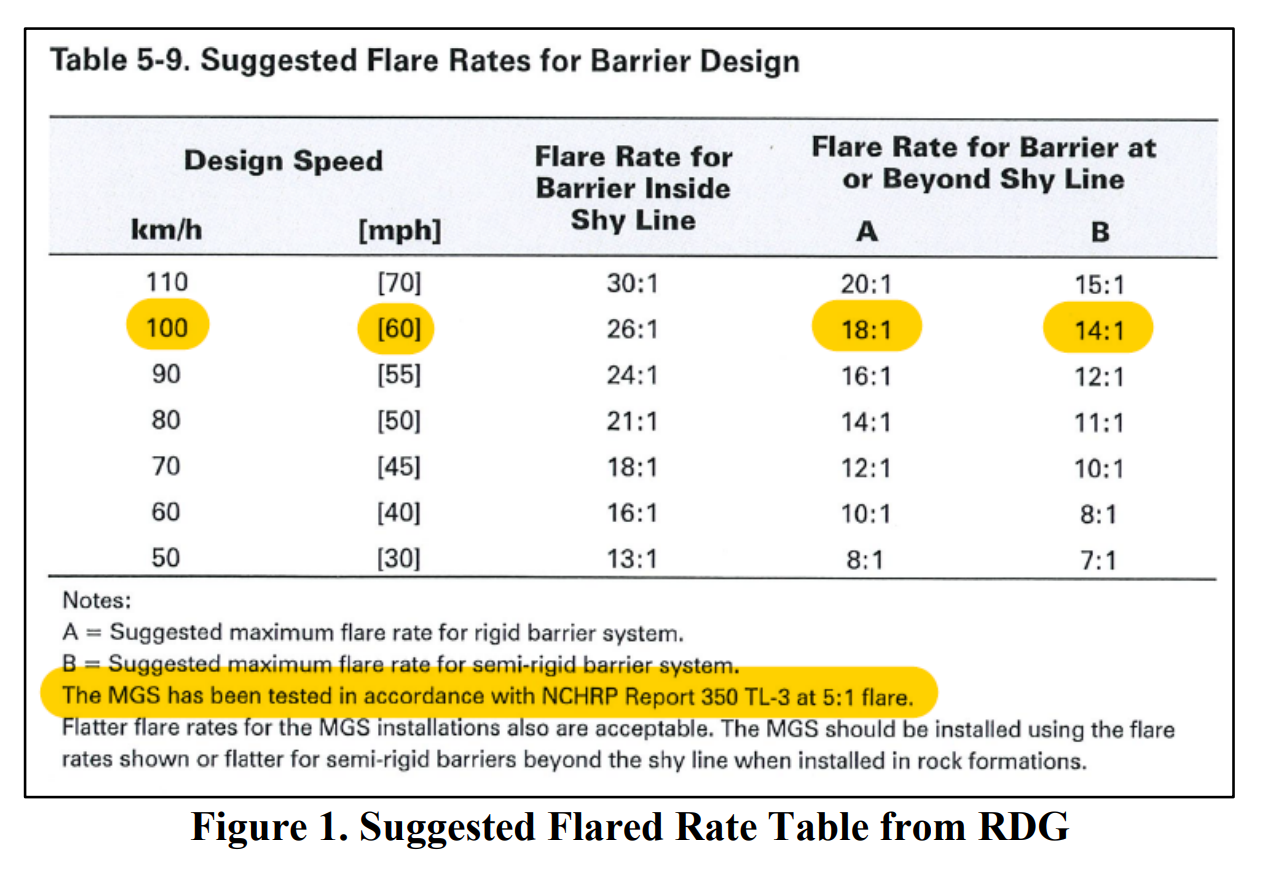
This proposed research is to continue an investigation following the recent pooled fund projects T4541-CV “Testing and Evaluation of the MGS System with Critical Flare at MASH Test Level 3 Conditions” [1] and T1969-AO “MASH TL-3 Design, Testing, and Evaluation of a Flared Guardrail System – Phase 2” (ongoing). The purpose of the projects was to investigate the critical flare for the Midwest Guardrail System (MGS) under American Association of Highway and Transportation Officials (AASHTO) Manual for Assessing Safety Hardware (MASH) [2] Test Level 3 (TL-3) testing and evaluation criteria. Critical flare rates for the MGS system were only investigated according to TL-3 criteria per previous NCHRP Report 350 standard requirements. Currently, AASHTO Roadside Design Guide (RDG) [3] Table 5-9 lists suggested flare rates for barrier design based on NCHRP Report 350 test results as shown below (Figure 1).
For project T4541-CV “Testing and Evaluation of the MGS System with Critical Flare at MASH Test Level 3 Conditions”, the research team conducted crash tests on the MGS system using three different configurations. Based off RDG Table 5-9, the initial MGS system had 6 ft–3 inch post spacing with rail splice off the post and standard steel post length of 6 ft at a 7:1 system flare rate. The system was tested under MASH Test 3-10 conditions, and the test failed due to the rail rupture. The second crash test was MASH Test 3-11 conducted on the MGS system with same system characteristics as the first test but with an 11:1 flare rate. The test failed due to anchorage failure. The last crash test was very similar to the second test. The test was conducted on the MGS system with the same characteristics as tests 1 and 2 at an 11:1 flare rate while using a proprietary MASH end terminal. The last test failed due to rail rupture. All three crash tests conducted on the project failed due to structural inadequacy. Figure 2 shows the tested system drawings, a test installation photo after impact, and the reason for failure.

Objective

The successful completion of MASH TL-3 crash tests will provide a modified MGS guardrail system on a flare at the steepest possible flare rate (goal is a 14:1 flare rate matching the current RDG recommended flare rate for semi rigid barrier but will use flatter rates if warranted).

Benefits

A successful design will provide the steepest MGS flared option to state agencies with easy to construct modifications. State agencies can retrofit the unmodified flared MGS since unmodified MGS at 25:1 or sharper flare rate cannot be adopted based on the findings from the Phase 1 and Phase 2 projects.

Products

The TTI research team will provide a final report that will summarize computer simulation results, the results of the MASH TL-3 full scale crash testing, provide appropriate system implementation/retrofit recommendations, and provide recommendations for further research opportunities if needed.

Work Plan

The work plan for this research includes the following task.

Task 1 – Computer Modeling and Simulation
Task 1 involves evaluating various modifications to the MGS and assessing multiple flare rates to identify an optimal modified MGS configuration for subsequent crash testing. The primary objective is to achieve a 14:1 flare rate; however, flatter flare rates will be considered if justified by the analysis. Preference will be given to modifications, or combinations of modifications, that are simple and cost-effective to construct—such as using 10-gauge rail, nested rail, and shorter blockouts. More complex or expensive modification options, such as half or quarter post spacing and rubrail additions, will be given lower priority and only evaluated if necessary. The range of flare rates evaluated will be guided by previous crash test data and recommendations from TTI researchers, with the primary goal of identifying the steepest feasible flare rate (targeting 14:1) that meets MASH requirements.
 
Task 2 – MASH Test Level 3 Full-Scale Crash Testing
Under Task 2, the selected modified MGS design will be constructed in accordance with design details. Full-scale crash testing will then be conducted in accordance with MASH Test Level 3 criteria, specifically MASH Test 3-10 (passenger vehicle) and MASH Test 3-11 (pickup truck). All crash tests will be performed and evaluated in strict accordance with MASH evaluation criteria.

Task 3 – Reporting
A comprehensive final report will be prepared that details the testing results, provides implementation/retrofit recommendations, and gives suggestions for future research, as applicable. Additionally, if warranted, technical support will be provided for submitting an FHWA eligibility letter request.      

Time Schedule

Started: April 2026 Time frame: 18 Months