TTI Research Supervisor: James C. Kovar, E.I.T. Associate Transportation Researcher Texas A&M Transportation Institute TAMU 3135 College Station, Texas 77843-3135 (979) 317-2680 [email protected]
Pooled Fund Technical Representative: Ted Whitmore Traffic Engineering Division Director WV DOT – Traffic Engineering Building 5, Room A-220 1900 Kanawha Blvd E. Charleston, WV 25305-0430 (304) 414-7373 [email protected]
Background (and Problem Statement)
The Roadside Safety Pooled Fund has prioritized their research needs for various barrier systems. A multi-directional breakaway mechanism design for large sign assemblies is desired for installations near intersections. One concern with this design is minimizing cost to the states during implementation. Currently, states may have large inventories of existing sign assembly components. Therefore, one desired objective is to develop a retrofit option for a unidirectional to multi-directional design that will maximize use of existing installations and inventories. This topic was investigated under earlier projects, but several failures in crash testing occurred. Therefore, this project is aimed at continuing the effort to develop a MASH compliant solution (1). The previous testing setbacks involved a large guide sign system, and this Phase I project will focus on improving this previously tested design. Phase II, reserved for future prioritization and funding, will evaluate the large route marker assembly which the research team began to evaluate under the previous project.
Objective
The primary objective of this study is to develop a multi-directional breakaway mechanism design for large sign assemblies. This effort will use engineering analysis and full-scale dynamic testing to evaluate the system’s crashworthiness.
Benefits
This project will benefit the members of the Roadside Safety Pooled Fund by providing a multi-directional breakaway mechanism design for large sign assemblies. This will allow states to use a MASH compliant design when installing large sign assemblies near intersections. A retrofit design will maximize use of existing materials while minimizing cost to the members of the Roadside Safety Pooled Fund.
Products
The TTI research team will develop a multi-directional breakaway mechanism design for large sign assemblies through engineering analysis and component testing. The TTI research team will prepare and submit a research report fully documenting the work completed within this project. The TTI research team will submit this report to the technical representative of the Roadside Safety Pooled Fund for review and approval.
Work Plan
The work plan for this phase will consist of two tasks. The first task is titled Engineering Analysis and Design. The second task is titled Crash Testing.
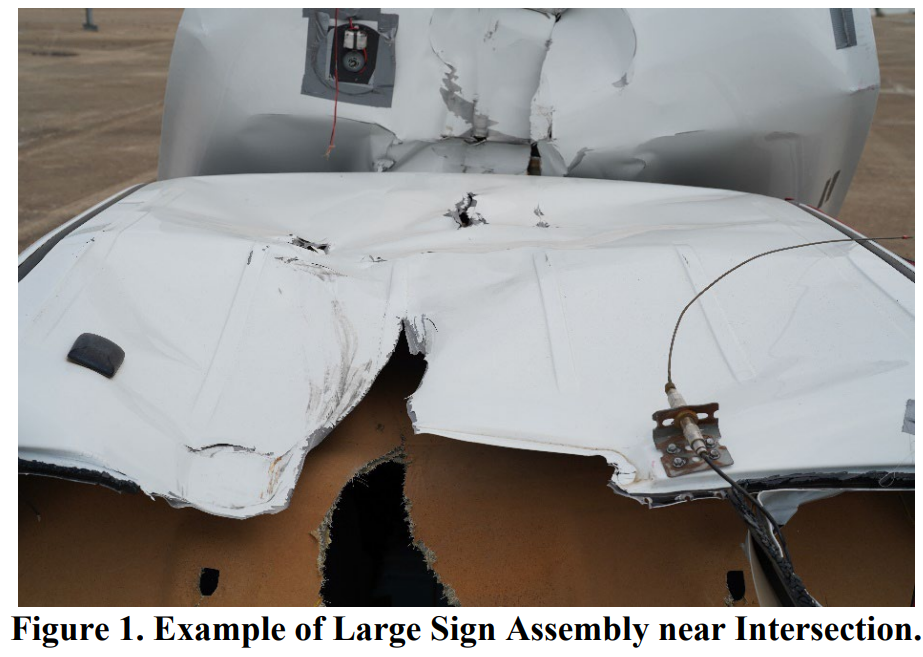
Task 1: Engineering Analysis The Task objective is to develop a multi-directional breakaway mechanism design for large sign assemblies. In the previous project, the research team suffered setbacks in MASH crash testing of a large guide sign design. Figure 1 shows the vehicle damage after the first crash test. A variety of design options were investigated under the previous project, including a modified fuse plate and an increase in mounting height. The research team will evaluate the failures of the previous crash testing and develop a design modification to improve the crashworthiness performance. Figure 1. Example of Large Sign Assembly near Intersection.
Task 2: Crash Testing The Task objective is to complete full-scale crash testing of the system developed in Task 1. The research team will run tests under conditions set forth in MASH for evaluating sign support structures. These test conditions evaluate a device’s crashworthiness with respect to high and low speed impacts. The research team will install the intended design of the sign support near intersections, and therefore, investigate both directions of travel. This task also includes the reporting and documentation of the project’s effort. The TTI research team will prepare and submit a research report fully documenting the work completed within this project. The research team will submit this report to the technical representative of the Roadside Safety Pooled Fund for review and approval.